The Best Fluffy Pancakes recipe you will fall in love with. Full of tips and tricks to help you make the best pancakes.


Mapping your kitchen into cooking zones means grouping every tool and ingredient by task, so you stop making a mad dash for a spatula mid-recipe.
You split your space into dedicated areas for prepping, cooking, washing, and storing, with tools placed right where you actually use them. This saves steps, reduces mental clutter, and makes cooking feel easier.
Curious how to set yours up?
Kitchen Zone Mapping: A Definition
Since you’re always moving around your kitchen while cooking, wouldn’t it be nice to cut down on all that back-and-forth? Kitchen zone mapping does exactly that by splitting your space into dedicated areas for each task. You’ll have distinct kitchen zones for food storage, food prep, and the cooking zone, so everything you need lives right where you use it.
For example, keep your cutting board and knives near the sink, not across the room. This method helps you organize your kitchen around your actual workflow, reducing wasted steps. It’s inspired by the classic work triangle but gives you more flexibility, overlapping items like spices near the stove without losing each zone’s purpose. Experts recommend storing rarely used items in the hardest-to-reach spots, like high shelves or the back of deep cabinets, so prime areas stay reserved for what you use every day.
The result? Less shuffling, more cooking.
How Kitchen Zones Solve the Work Triangle’s Biggest Flaw
You’ve probably heard of the kitchen work triangle, but its biggest flaw is that it locks you into just three fixed points: stove, sink, fridge.
Zone-based layouts break free from that outdated thinking by letting you group tools and tasks however your actual cooking flows.
You’ll gain real flexibility, like claiming prime counter space for your morning coffee station without the triangle’s rigid spacing rules.
For example, in a U-shaped kitchen, placing the fridge and cooktop at opposite ends with the sink centered between them keeps your prep zone intuitive and reduces unnecessary movement.
Outdated Layout Constraints
You never cook in a straight line. Zones work because they overlap naturally, but the triangle doesn’t account for that.
Dedicated areas like a prep zone or cleaning zone handle single tasks, cutting wasted steps. Family breakfasts, baking, and dishwashing happen simultaneously.
The triangle can’t juggle multiple roles.
Spices and oils sit near the hob, not by the fridge.
Zones let you store items where you actually use them.
The triangle ignores this simple fact.
Zone mapping reduces “kitchen miles” by grouping actions—mise en place, cooking, cleaning—into honest sequences. In professional kitchens, placing undercounter refrigeration within reach of prep surfaces is a direct application of this principle, keeping ingredients exactly where the work happens.
Your kitchen does more than three things.
Don’t let outdated geometry limit it.
Zone-Based Flexibility Gains
Because the work triangle locks you into just three spots, zone-based layouts give you the freedom to spread out without wasting steps.
By dividing the kitchen into five or six task areas, you’re not stuck.
Your cooking gear—pots, tongs, spatulas—is within arm’s reach in the cooking zone, so you don’t race around for a fish turner.
Your meal prep zone overlaps with that zone, moving ingredients easily from chopping directly to the stovetop.
It makes multi-tasking feel effortless.
Secondary functions, like pouring drinks from an island, become easier to access without crossing the main work path.
You lose the old triangle’s rigidity and gain real flexibility, well, sanity.
Zone mapping reduces “kitchen miles” and keeps you flowing naturally, even when your meal plan changes.
Distinct zones also support cleanup zone efficiency, keeping everyday dishes, glasses, and silverware stored at arm’s reach near the dishwasher rather than scattered across the room.
The 5 Core Cooking Zones Your Kitchen Needs
You’ll start with the Food Storage Zone, making sure your pantry and fridge are close at hand so you can grab ingredients without losing your train of thought.
Right next to that, set up your Preparation Zone with a clear counter for chopping and measuring, because no one wants to hunt for a cutting board mid-recipe.
Finally, anchor the whole flow with the Cooking Zone, where your range and tools live together, keeping you from crossing the kitchen with a hot pot. Within your Food Storage Zone, grouping similar items into pantry zones by category helps reduce searching so you can move smoothly from grabbing ingredients to prepping and cooking without breaking your stride.
Food Storage Zone
At the heart of every kitchen that flows, you’ll find the Food Storage Zone: your pantry, cupboards, and go-to spot for all the dry goods and cooking basics. This organized space cuts down your kitchen miles and saves you time during prep.
It’s where you keep your important dry goods and items you need for everyday cooking.
- Store everyday food staples like dry goods, oils, spices, and flavorings close to the cooking area.
- Group prep essentials together: salt, pepper, and baking ingredients you reach for first.
- Keep frequently used items you need at eye level, not buried in the back.
- Arrange by category—baking, spices, grains—so you’re not hunting mid-recipe.
- Include storage containers here for easy leftovers, without wandering to other zones.
Use clear modular bins with matching lids and labels in your pantry to spot duplicates quickly and identify low-stock items before they run out.
This zone reduces busywork, letting you grab what you need without a scavenger hunt.
Preparation Zone Setup
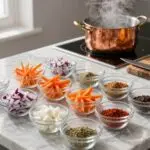
Finally, place oils, salt, pepper, and spices within easy reach for efficient seasoning while you cook. Store any chopped vegetables in airtight containers for freshness so they stay crisp and ready to use for up to three to five days. Your kitchen will thank you!
Cooking Zone Essentials
Since your range or cooktop is the heart of meal-making, the Cooking Zone should be its loyal sidekick. This central spot keeps all your heat-loving tools and ingredients within arm’s reach, turning chaotic kitchen work into effortless sailing.
You don’t want to hunt for a needed item or trek across the kitchen for every pinch of salt or flip of a spatula.
Store your most cooking utensils—tongs, spatulas, wooden spoons—right next to the burners so you’re always ready to stir or flip. Keep frequently used ingredients like oils, salt, and spices nearby for quick seasoning without walking away.
Position your measuring cups and mixing bowls close to the prep side, so you can grab them fast. Handoffs from mise en place to the pan become seamless.
Use sheet pans as staging areas in larger kitchens to move food from prep to cook efficiently. Treat the zone as part of your broader triangle connecting cooker, prep, and cleaning so your flow stays logical from stirring to plating.
According to NKBA kitchen planning guidelines, each leg of the work triangle connecting your refrigerator, sink, and stove should measure between 4 and 9 feet to keep your Cooking Zone reachable without unnecessary steps.
What Each Kitchen Zone Should Hold (and Where to Put It)
Before you even pick up a spatula, it helps to know exactly where everything should live, and that’s where kitchen zones come in. Start with dividing your kitchen into clear zones, beginning with the Prep zone.
Here, keep everything you need for chopping and measuring: cutting boards, knives, peelers, and scales.
Stash them on a dedicated counter near the sink and dishwasher, so you can wash produce and utensils without trekking across the room. This setup slashes the amount of time you spend hunting for tools, letting you focus on the recipe instead.
For the Cooking zone, store pots, pans, and heat-safe spatulas right by the hob—no more fumbling mid-simmer.
The Cleaning zone clusters your sink, dishwasher, and supplies like soap and sponges for easy unloading.
Finally, the Putting-away zone puts dishware and wrap near the dishwasher, so cleanup flows straight into storage. To keep all these zones working together efficiently, the kitchen work triangle connects your refrigerator, sink, and stove so each area stays within easy reach during meal prep.
Why Zone Mapping Cuts Kitchen Time and Mental Effort

Think of your kitchen as a system where every item has a purpose and a place, and zone mapping is the method that makes that system visible. When zones are defined clearly, movement through the kitchen becomes intentional rather than reactive, which shortens the time spent locating tools and ingredients during meal preparation. This kind of spatial organization pairs naturally with habits like batch cooking, where pre-portioned proteins, sauces, and freezer-ready meals are built in advance to remove nightly decision fatigue and reduce the fridge-staring panic that hits at 6 PM.
Start Zone Mapping Today: A Step-by-Step: A Step-by-Step Guide
You’ve already seen how mapping your kitchen zones can cut your time and mental effort. Now let’s make it real.
To start zone mapping, watch your own routine for 2–3 days. Note exactly where you pull items from, chop, cook, wash, and put things away. This reveals your natural workflow.
To start zone mapping, observe your own routine for two to three days to reveal your natural workflow.
Pick one small area first, like the prep zone near the range or sink. Pull everything from a drawer or cabinet, and regroup it strictly by particular task—cutting, measuring, washing. Then place tools where you use them.
Keep cookware and cooking helpers in the cooking zone, and cleanup gear around the sink.
Use zone-to-zone overlap on purpose. Store quick necessities like salt, pepper, and oils near the cooking/prep boundary. Don’t force every item into a single strict spot.
Make steady improvements one zone at a time, cutting unnecessary steps every time you work. You’ll quickly reduce “kitchen miles” and make mise en place easier in any common kitchen.
Customizing Zones for Your Lifestyle
No two kitchens work exactly the same, which is exactly why you get to make zone mapping your own. You can customize based on your daily habits and need for efficiency.
- Prep Zone: This zone includes your cutting board, knives, and mixing bowls. Keep everyday items like spices and oils close if you use them while cooking; they’ll have a designated home near the stove.
- Beverage Zone: Give your coffee routine prime real estate. Dedicate a spot for your machine, mugs, and fridge items. Everything makes sense when clustered for quick morning access.
- Baking Zone: If you bake often, store flour, sugar, and measuring tools together. Your mise en place becomes a breeze when every utensil has a designated home.
- Allergen-Safe Zone: For gluten-free needs, create a separate prep station. This reduces cross-contamination risk and keeps your workflow stress-free.
- Multi-User Zone: Place a prep station near the hob so two cooks can move fast. Your kitchen runs effortlessly when every zone includes the tools you need.
Final Thoughts
So, you’ve got the blueprint for a kitchen that actually works with you, not against you. Mapping your zones isn’t about perfection: it’s about saving your sanity.
You’ll stop hunting for the right spatula or walking ten extra steps for a pot. Give it a try this weekend. Trust me, your future self (and your tired feet) will thank you.
Happy cooking!