The Best Fluffy Pancakes recipe you will fall in love with. Full of tips and tricks to help you make the best pancakes.



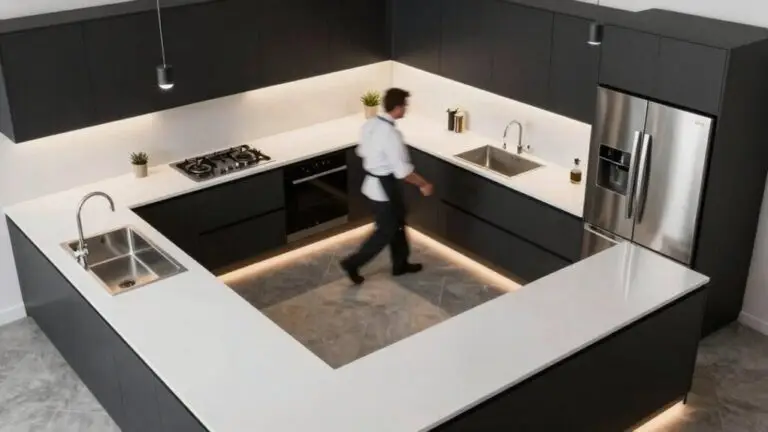
Your kitchen’s work triangle might be ruining your flow with five common mistakes. An island blocking the direct path between your sink, stove, and fridge creates annoying detours.
Placing your fridge too far away forces extra steps for simple tasks. Putting the sink and cooktop on opposite sides disrupts your cooking rhythm. You can test your layout with a quick pencil sketch—just draw straight lines between your three main stations.
Fixing these issues keeps your movements streamlined and calm, and you’re ready to see the simple solutions.
5 Signs Your Kitchen Work Triangle Is Broken (And What to Do First)
Fix it by adding landing zones: aim for 24 inches on one sink side and 15 inches beside the cooktop. This simple shift ends the relay race, turning chaos into calm. If you have an island, position it to support the kitchen work triangle by keeping the sink, stove, and fridge within easy reach of one another.
Your space next to each station becomes functional, not frustrating.
How an Island Can Break Your Kitchen Work Triangle
Because an island can quietly sabotage your kitchen’s flow, it often turns that sleek triangle into a frustrating obstacle course.
When your kitchen island blocks the direct path between the sink, fridge, and stove, you’re not working—you’re detouring.
You need 42–48 inches of clearance around the island to keep that work triangle accessible.
Less than that, and even small islands become bottlenecks during busy cooking and cleaning.
A poorly planned island also disrupts appliance door swings, meaning every time you open the dishwasher or trash cabinet, the triangle path breaks.
It can also steal landing space next to the stove, forcing extra trips that ruin efficiency.
If your island’s seating crowds the busiest zone, you’ll avoid following the triangle at all.
Seating areas specifically need about 44 inches of clearance so stools can slide out without blocking the traffic path through your work triangle.
That’s how even the most beautiful island breaks your kitchen’s heart.
Your Fridge Is Too Far From the Stove (Fix This First)
Why is your fridge so far from the stove? That’s the number-one work triangle mistake you need to fix first.
When your fridge sits miles away, you’re walking a frustrating path just to grab milk or eggs. This breaks your prep area flow completely.
When your fridge sits miles away, just grabbing milk or eggs breaks your entire prep flow.
You end up crossing high-traffic areas, adding unnecessary steps between the fridge, sink, and stove.
The NKBA suggests keeping those three points close—measure the actual walkway; you don’t want thirty inches of walkway turning into thirty feet of back-and-forth.
Without a handy counter for landing groceries, you’ll struggle to stage ingredients before cooking.
It doesn’t make a big impact now, but over time those wasted trips drain your energy.
Relocate the fridge or rework counters so your movement stays direct and won’t cut through a congested walkway. According to NKBA kitchen planning guidelines, each leg of the work triangle should measure between 4 and 9 feet, with the total perimeter falling between 13 and 26 feet.
Sink and Cooktop on Opposite Sides? Here’s the Fix

You’ve fixed the fridge-to-stove gap, but now there’s another common layout snag: the sink and cooktop end up on opposite sides of the kitchen. This is one of those Common Kitchen Layout Mistakes that forces you to ignore the work rhythm. You’re constantly crossing the room for a simple rinse or to transfer a pot. Don’t let that ruin your daily use.
Fix it by carving out a landing zone of at least 24 inches of counter space next to the sink for prep and staging. That gives you enough space to wash and organize ingredients before moving them over.
Then, add 15 inches of counter on each side of the cooktop for seasoning and plating. If repositioning isn’t an option, install a small peninsula or prep counter to bridge the gap. This keeps your meal prep flowing without backtracking across the room. According to kitchen design guidelines, the sink-to-cooktop distance should fall between 4 and 9 feet to keep your triangle tight and eliminate the need to hike across the room during cooking.
Test Your Kitchen Work Triangle in One Simple Step
What’s the simplest way to test your kitchen work triangle without any fancy tools? Grab a pencil and sketch your layout, then draw a straight line between the fridge, sink, and cooktop. Walk it in your mind—if you’re making awkward detours, you’ve got common mistakes to fix.
Here’s what to check for a kitchen that works:
Measure the triangle sides: aim for 4 to 9 feet each. Cramped under 4 inches means bumping, while over 9 forces sprinting during your daily routine.
Keep your kitchen triangle sides between 4 and 9 feet—avoid bumping or sprinting.
Make sure the path stays clear—no island or tall counter blocks easy movement. You shouldn’t have to reroute mid-step.
Include appliance door swings (fridge, dishwasher) in your walk. If they block your flow, your dream kitchen needs adjustment.
Verify you can move fridge → sink → stove in a seamless loop without backtracking. If not, your space has mistakes.
Adjust to hit the “sweet spot” for a beautiful kitchen that lets you improve functionality without stress.
The total triangle perimeter should fall between 13 and 26 feet to avoid exhausting movement or cramped conditions that disrupt your cooking rhythm.
This one test reveals if your kitchen’s triangle or your dream kitchen actually supports your cooking flow. Fix those inches and enjoy effortless prep.
Final Thoughts
So, don’t let a cramped or sprawling kitchen ruin your groove. You’ve got the tools to fix that broken work triangle, even if it means moving your island or shifting your fridge closer. Test it with a simple walk-through; your cooking flow will thank you.
A few smart tweaks can turn chaos into calm, making meal prep feel almost effortless. After all, you’re the chef here. Your kitchen should work for you, not the other way around.