The Best Fluffy Pancakes recipe you will fall in love with. Full of tips and tricks to help you make the best pancakes.


Think of your kitchen like a racetrack: five stages keep food moving in one seamless loop. First, you route deliveries straight to storage, using first-in-first-out to prevent spoilage.
Next, you place prep areas near that storage, cutting wasted steps before cooking begins. Then, you arrange your cook line and expo for zero backtracking. After that, your pass positions plated meals for quick server handoffs.
Finally, dish return closes the loop, clean from dirty. Curious how to build each stage?
Receiving and Storage: Start Your Workflow Without Delays

Since you want your kitchen to run without constant traffic jams, it pays to start at the very beginning: receiving and storage. When deliveries arrive, you’ll route them straight to cold storage or dry storage, keeping them away from the main prep area. That’s smart workflow planning.
Starting your kitchen workflow at receiving and storage prevents traffic jams before they start.
In commercial kitchen layouts, equipment placement near the kitchen entrance cuts wasted steps. You don’t want your team trekking past dirty dishes or crossing cooking lines just to stash ingredients. That just kills service speed.
Keep non-food supplies separate, too. A clean zone for food preparation starts right here. No piling boxes by the door—use staging rules so items move quickly. You’ll prevent bottlenecks before they start.
When stocking dry storage, place newer inventory behind older stock using the first-in-first-out method so your team always reaches for ingredients closest to their expiration date first.
Remember: a seamless receiving flow means faster ticket times later.
Prep and Portioning: Save Steps Before the Heat Hits
Once you’ve got your ingredients stowed away neatly, it’s time to shift focus to prep and portioning, the zone where you save steps before the heat hits.
Your prep areas should live near storage, so food leaving for the cooking line doesn’t backtrack.
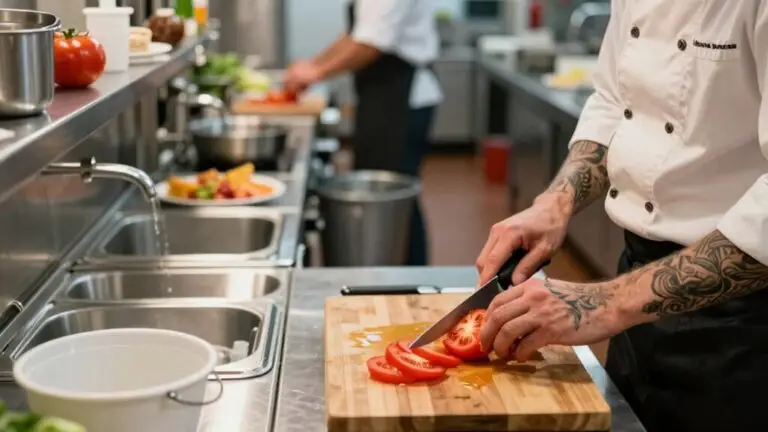
Split things up for raw-to-ready-to-eat separation; it cuts staff movement and keeps things safe.
Micro-layouts are your friend here, keep oils and seasonings within arm’s reach at each station.
That way, you’re not running in circles during high production volume.
Design portioning so plates flow straight to the next step, tightening ticket time.
Plan dedicated prep sinks nearby, clear of clutter, so you wash up fast right before cooking.
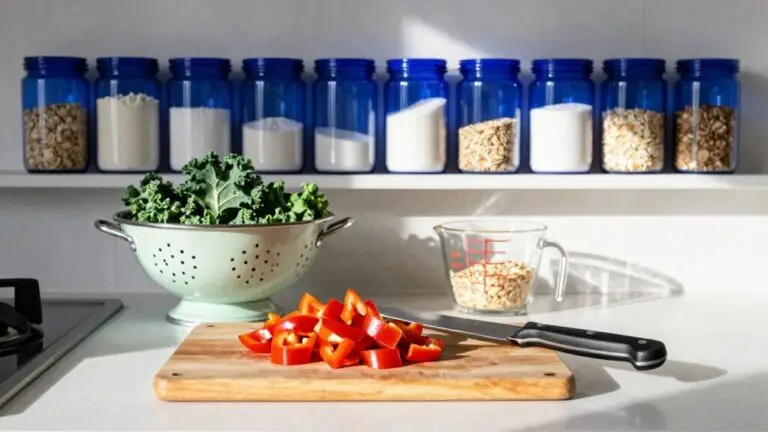
Pre-measuring ingredients into bowls before production begins can cut active cooking time by as much as half by eliminating the pauses that come from hunting down missing components mid-service.
Smart layouts here mean less chaos later.
Cook Line and Expo: Arrange Stations for Peak Workflow Speed
When your cook line flows like a relay race, you’ll crush ticket times without breaking a sweat. Place your cook line so ingredients travel straight from prep to your cooking stations—grill, sauté, fryer, oven—with zero backtracking. That’s smart food flow design.
Position the expo/pass immediately after, giving finished dishes a fast, predictable route to the dining room. Arrange stations based on shared dependencies.
Keep the fryer near your plating/expo point so fried items don’t cross other streams.
Use a linear, one-direction flow (raw → cooking → plating/expo → service) to cut contamination risk and cross-traffic. Once service begins, you’ll thank yourself for keeping aisles at least 48 inches wide.
That’s enough room for two staff to pass safely during peak service, so your expo/pass stays clear and ticket times stay fast. Much like a galley kitchen’s parallel walls, this linear arrangement keeps your most critical stations within arm’s reach of one another, eliminating wasted steps during peak service.
Plating and the Pass: Smooth Handoffs for Faster Service

The plating zone and the pass are where all your kitchen’s hard work pays off or stalls out. Here, food flow design turns peak service chaos into calm.
Your pass should sit right on the edge of the dining room, creating a fast handoff from cooks to servers. That short, direct path protects ticket times and keeps dishes hot.
Use micro-layouts at the pass, with dedicated staging for each order, so your expo never becomes the bottleneck.
Design for one-direction flow: plated meals move forward, while dirty items head toward warewashing. This reduces cross-traffic and contamination risk.
As part of smart commercial kitchen design, you’ll see inefficiencies become obvious. A clear, seamless pass means higher service quality and fewer frustrated servers. Maintaining at least 42 inches of clearance around high-traffic staging areas at the pass keeps service moving without bottlenecks or collisions during a rush.
Dish Return and Wash: Close the Workflow Loop Efficiently
Just as you’ve got that hot plate flying from the pass to the table, you’ve also got a wave of dirty dishes heading back your way. Design your dish return to complete a clean-to-dirty loop: finished meals exit on one side, soiled dishes enter on the other—no crossing paths with your food flow.
Place your warewashing, dirty staging zone near the kitchen entrance, not deep in the back. That’s where bus tubs, soiled dish sorting, and plate waiting happen, separate from prep lanes. Use three-compartment sinks for utensils and rapid warewashing machines to keep throughput high.
Keep return circulation clear and supervised; cramped layouts cause injuries (over 93,800 in 2019). Maintaining at least 3.5 feet clearance around any fixed station or island prevents forced detours that bottleneck dish return traffic. A seamless loop means less chaos and safer, faster service.
Final Thoughts
So there you have it, the five stages of kitchen flow, from receiving to the dish pit. Nail each one, and you’ll stop tripping over your own team. You’re not merely moving food; you’re building a rhythm that feels almost effortless.
Sure, a little chaos is part of the gig, but a smart layout? That’s your secret weapon. Design it right, and you’ll turn a stressful shift into a slick, satisfying dance.