The Best Fluffy Pancakes recipe you will fall in love with. Full of tips and tricks to help you make the best pancakes.


Last updated: March 28, 2026
Quick Answer: Organizing your kitchen from scratch means clearing everything out, deciding what stays, and then rebuilding storage around how you actually cook. The zone-by-zone method groups items by task (cooking, prep, cleaning, storage) so everything lives where you need it. Most kitchens can be fully reorganized in a weekend with no special tools required.
Key Takeaways
- Start by emptying your kitchen completely before deciding what to keep
- Divide your kitchen into functional zones: cooking, prep, storage, cleaning, and beverages
- Store items closest to where you use them to save time and reduce clutter
- Drawer dividers, pull-out bins, and clear containers are worth buying for most kitchens
- A well-organized kitchen improves everyday cooking and reduces decision fatigue
- Label everything in your pantry zone, even if it seems obvious now
- Avoid overfilling cabinets — breathing room makes it easier to maintain
- Revisit your system every 3–6 months and adjust as your cooking habits change
Why Most Kitchen Organization Fails (And What to Do Instead)
Most kitchen organization attempts fail because people organize around their storage, not around how they cook. They tidy up what’s already there instead of rethinking the whole system.
This guide takes a different approach. Following this How to Organize Your Kitchen From Scratch: Zone-by-Zone Guide means starting with a blank slate, then rebuilding storage around your actual kitchen workflow — not around what fits in the cabinet.
The zone method works because:
- It cuts down the steps between grabbing an item and using it
- It groups related tools together so you stop hunting for things mid-cook
- It makes it easier to put things back, which keeps the kitchen tidy long-term
🏠 Kitchen Zone Setup Checklist
Check off each task as you organize your kitchen zone by zone
Click a zone to expand it, then check off tasks as you complete them.
Clear & Declutter
+
Start fresh — empty everything before organizing.
Cooking Zone
+
Everything needed at or near the stove.
Prep Zone
+
Your main countertop workspace for chopping and mixing.
Food Storage Zone
+
Pantry, cabinets, and shelves for dry goods and spices.
Cleaning Zone
+
Around the sink and dishwasher — keep it tidy and functional.
Beverage Zone
+
Coffee, tea, and drinks — keep it self-contained.
Overall Progress
0 / 28 tasks
Start by expanding a zone above ✓
Step 1: Empty Everything Out First
Before organizing a single drawer, take everything out of your kitchen. Every cabinet, every drawer, every shelf.
This step feels extreme, but it's the most important one. You can't build a better system on top of a broken one.
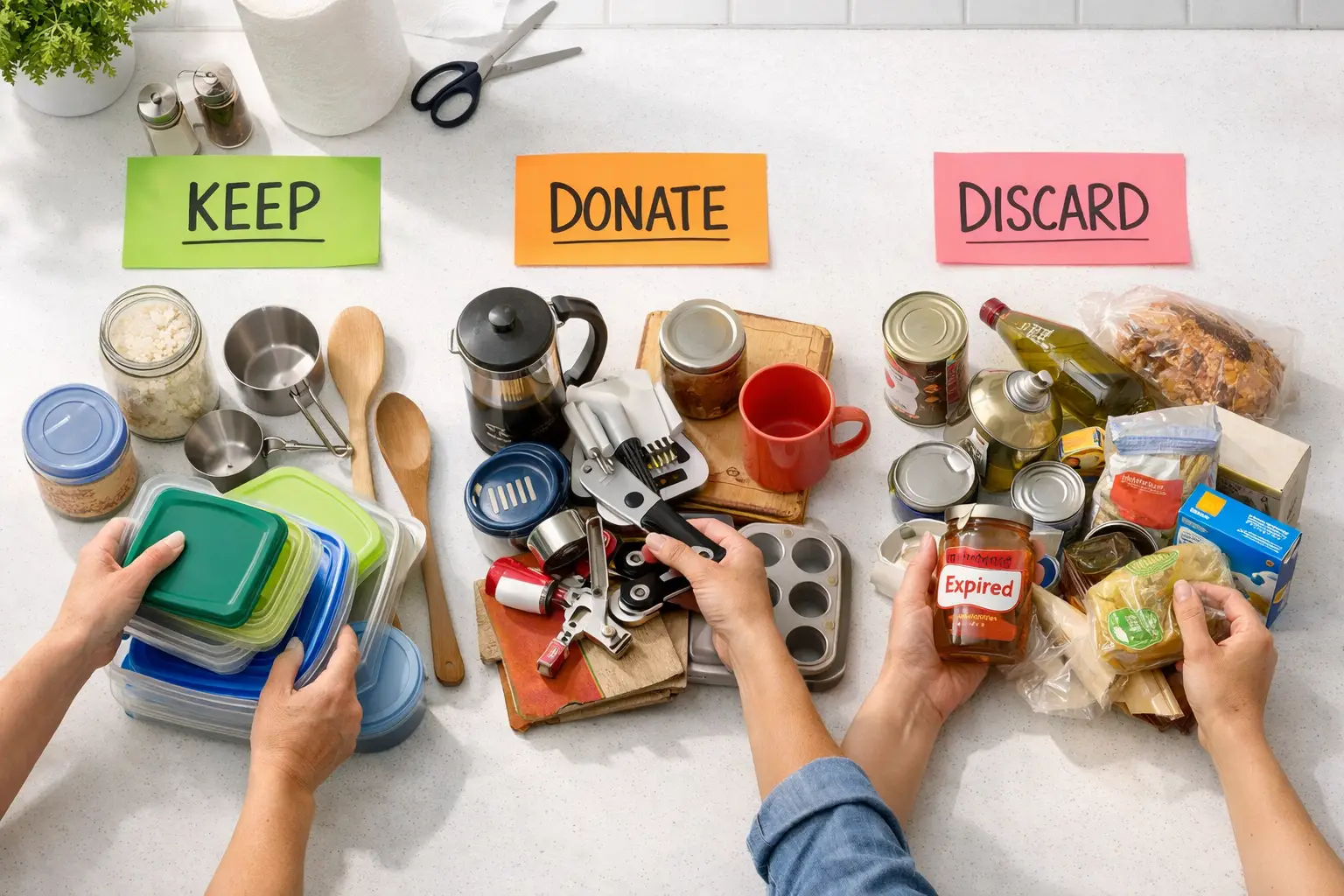
What to do with everything once it's out:
| Category | Action |
|---|---|
| Duplicates (3 spatulas, 2 colanders) | Keep one, donate the rest |
| Broken or damaged items | Discard immediately |
| Items used less than once a year | Donate or store elsewhere |
| Items you genuinely use | Keep and sort by task |
| Mystery gadgets | Be honest — if you don't know what it does, it goes |
Common mistake: Keeping items out of guilt ("it was a gift") or optimism ("I'll use it someday"). A clutter-free kitchen is more practical than a sentimental one.
Step 2: Clean and Assess Your Space
With the kitchen empty, wipe down every shelf, drawer, and cabinet interior. This is also the time to assess what storage you actually have.
Ask yourself:
- Which cabinets are hardest to reach? (Store rarely-used items there)
- Where is the dead space? (Corner cabinets, high shelves)
- What's closest to the stove, sink, and prep area?
Measure deep cabinets and drawers if you plan to buy organizers. Buying first and measuring second is one of the most common (and expensive) mistakes in kitchen organization.
Step 3: Map Out Your Kitchen Zones
This is the core of the How to Organize Your Kitchen From Scratch: Zone-by-Zone Guide approach. Divide your kitchen into five functional zones based on what happens there.
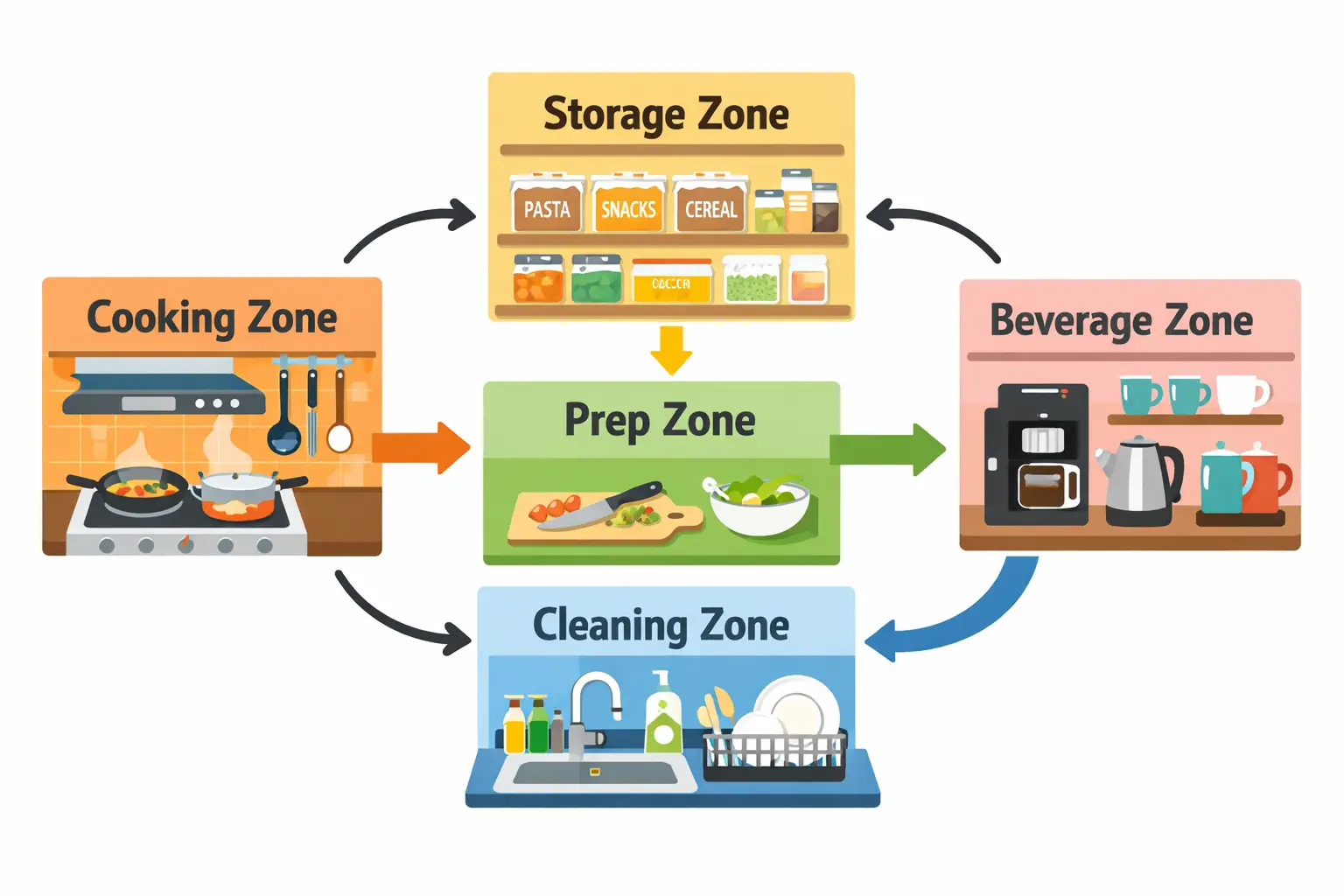
The 5 Kitchen Zones
🍳 Zone 1: Cooking Zone Centered around the stove and oven. Store here: pots, pans, lids, cooking utensils, oven mitts, and cooking oils.
🔪 Zone 2: Prep Zone Usually the main countertop area. Store here: cutting boards, knives, peelers, graters, mixing bowls, and measuring cups.
🥫 Zone 3: Food Storage Zone Pantry, cabinets, or shelving near the fridge. Store here: dry goods, canned items, snacks, spices, and baking supplies.
🧽 Zone 4: Cleaning Zone Around the sink and dishwasher. Store here: dish soap, sponges, dish rack, cleaning sprays, and trash bags.
☕ Zone 5: Beverage Zone Near the coffee maker or kettle. Store here: mugs, glasses, coffee, tea, filters, and a water pitcher.
Choose X if… You have a small kitchen with limited cabinet space: combine the beverage and prep zones on one countertop section, and use vertical wall storage for mugs and utensils.
Step 4: Organize Each Zone With Practical Storage
Once your zones are mapped, it's time to put things back — intentionally.
Cooking Zone Tips
- Use a pot rack or deep lower cabinet with a lid organizer
- Keep oils and salts in a small tray next to the stove (not in a cabinet)
- Hang frequently used utensils on a rail or in a crock on the counter
Prep Zone Tips
- A magnetic knife strip saves counter space and keeps blades accessible
- Store cutting boards vertically in a slim rack — much easier to grab
- Keep measuring cups and spoons on a hook inside a cabinet door
Food Storage Zone Tips
- Decant dry goods (pasta, rice, flour) into clear, labeled containers
- Group spices alphabetically or by cuisine type — pick one system and stick to it
- Use pull-out bins for snacks and canned goods so nothing gets buried
Cleaning Zone Tips
- A small caddy under the sink keeps cleaning supplies contained
- Add a tension rod under the sink to hang spray bottles and free up floor space
Beverage Zone Tips
- Stack mugs two-high max — more than that and things get knocked over
- Keep the coffee station self-contained so it's easy to use and easy to reset
Step 5: Add Organizers That Are Actually Worth Buying
Not every kitchen needs expensive storage products. But a few targeted buys make a real difference.
Worth buying for most kitchens:
- Drawer dividers (adjustable ones work across different drawer sizes)
- Clear stackable bins for pantry shelves
- A lazy Susan for corner cabinets or deep shelves
- Over-door organizers for cleaning supplies or spice packets
- A pot lid rack if lids are currently a chaotic pile
Skip unless you have a specific need:
- Specialized gadget organizers (most are too narrow or too deep)
- Decorative baskets without lids (they collect dust fast)
- Expensive drawer inserts that don't fit standard drawer sizes
How to Maintain Your Kitchen Organization System
A well-organized kitchen only stays that way if the system is easy to use. If putting something back takes effort, it won't happen consistently.
Quick maintenance habits:
- Do a 5-minute reset at the end of each day — return items to their zones
- Every time you buy something new, remove something old
- Check the pantry zone once a month for expired items
- Reassess the whole system every 3–6 months as cooking habits shift
Edge case: If you share the kitchen with others, label zones clearly. A simple label maker or even handwritten tags on shelves reduces the "where does this go?" problem significantly.
FAQ
How long does it take to organize a kitchen from scratch? Most kitchens take 4–8 hours for a full reorganization, spread across one or two days. Larger kitchens or heavily cluttered spaces may take a full weekend.
Do I need to buy storage products before I start? No. Empty the kitchen first, map your zones, then identify gaps. Buying organizers before you know your space often leads to products that don't fit.
What's the most important zone to get right? The cooking zone. It's where most kitchen frustration happens. Getting pots, pans, and utensils within easy reach of the stove has the biggest impact on everyday cooking.
How do I organize a small kitchen with very little storage? Prioritize vertical space (wall rails, over-door organizers, stackable shelves) and be ruthless about what stays. A small kitchen can only hold what you genuinely use.
Should spices go near the stove? Not directly next to it — heat and steam degrade spices faster. A nearby drawer or a cabinet adjacent to the stove is a better spot.
Is the zone method right for every kitchen layout? It works for most layouts, including galley, L-shaped, and open-plan kitchens. The zones may overlap or shift depending on where the stove and sink are, but the logic stays the same.
What do I do with items I rarely use but want to keep? Store them in the hardest-to-reach spots: high shelves, the back of deep cabinets, or a pantry closet. Keep prime real estate for daily-use items.
How do I stop the kitchen from getting cluttered again? The "one in, one out" rule is the most effective habit. Every new item that enters the kitchen means an old one leaves.
Conclusion
Organizing a kitchen from scratch doesn't require a renovation or a big budget. It requires a clear method, a willingness to let go of what isn't working, and a system built around how you actually cook.
The How to Organize Your Kitchen From Scratch: Zone-by-Zone Guide approach works because it's practical, not decorative. When everything has a logical home, cooking gets faster, cleanup gets easier, and the kitchen stops feeling like a source of stress.
Your next steps:
- Pick a day this week to empty one section of your kitchen
- Map out your five zones on paper before moving anything back
- Identify two or three targeted organizers that would genuinely help
- Set a reminder to do a 15-minute zone check in 30 days
Start small if a full overhaul feels overwhelming. Even reorganizing one zone makes a noticeable difference in your daily kitchen workflow.
References
- Kondo, M. (2014). The Life-Changing Magic of Tidying Up. Ten Speed Press.
- National Kitchen and Bath Association. (2022). Kitchen Planning Guidelines and Access Standards. NKBA. https://www.nkba.org
- University of California, Los Angeles (UCLA) Center on Everyday Lives of Families. (2012). Life at Home in the Twenty-First Century. UCLA Cotsen Institute of Archaeology Press.