The Best Fluffy Pancakes recipe you will fall in love with. Full of tips and tricks to help you make the best pancakes.


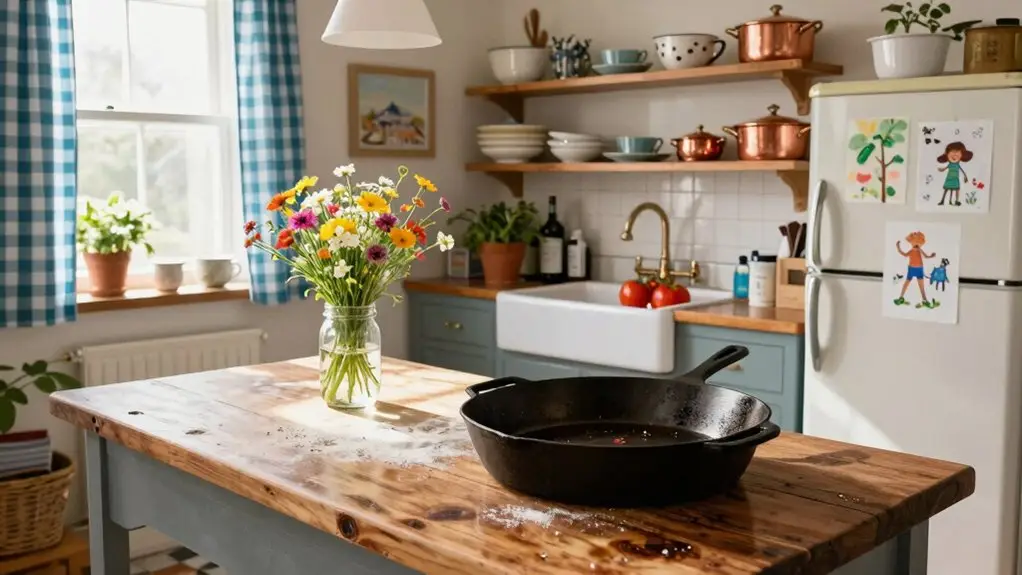
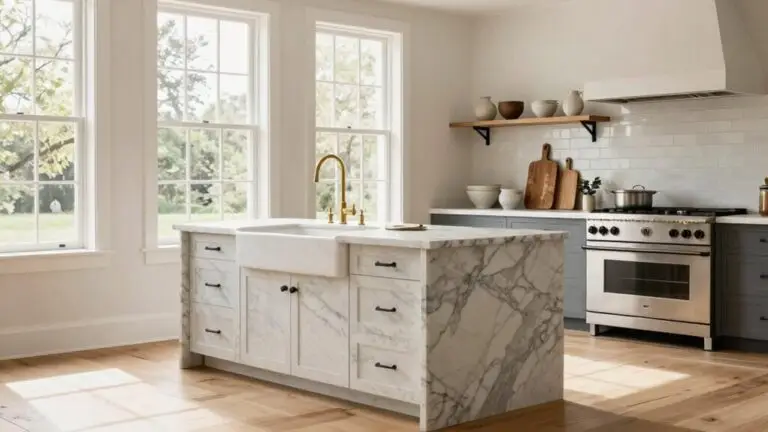
You’ve seen an American kitchen in every home design show. It’s that sunlit, open space with a big island where everyone’s gathered, pancakes sizzling while friends lean in with coffee. It became iconic because it evolved from smoky back rooms into the home’s social heart, blending practicality with flex-worthy style.
Those marble slabs and stainless steel appliances? They’re status symbols, yes, but they also tell a story of how families actually live together. There’s more behind that island than meets the eye.
What Defines an American Kitchen: Islands, Open Plans, and Daily Flow
The heart of an American kitchen isn’t fancy gadgets or sleek countertops, it’s the way the space moves with you. You’ll notice open layouts right away—these aren’t closed-off rooms but spaces that breathe and connect.
The heart of an American kitchen isn’t what you see—it’s how the space moves with you.
An open-plan layout lets natural light pour in from windows everywhere, making morning coffee feel like a bright ritual.
At the center, you’ll find the kitchen island. It’s where you’ll prep dinner one minute and host friends the next.
The island often holds key appliances: a hob, extractor hood, fridge—all within arm’s reach.
Pull up a stool to the breakfast bar, and suddenly you’re chatting while eggs sizzle.
In tighter city spaces, you’ll want to pick your island size carefully. Too big, and you’ll bump elbows. Too small, and you’ve lost your anchor.
A well-placed turntable organizer on the island or in a corner cabinet keeps condiments, spices, and pantry staples spinning into reach without cluttering your workspace.
1920–1950: From Back-of-House Utility to Front-and-Center Family Life
You’d hardly recognize an American kitchen from two hundred years ago. Back then, you’d find it shoved to the back of the house, fighting open fires and choking smoke while trying not to set your apron ablaze. You’d sweat through summers with poor ventilation and pray your icebox didn’t spoil the milk.
Then the late 19th century arrived, and everything shifted. Indoor plumbing and better stoves meant the kitchen moved closer to where you actually lived. Appliances became cleaner, safer, and suddenly worth showing off.
Gas replaced coal, servants’ quarters vanished, and you started gathering there yourself. Keeping a premium professional tool set on hand made it easier to install and maintain the new fixtures and cabinetry that came with these modernized kitchens.
The Work Triangle and the Invention of Kitchen Efficiency
The original vision boiled down to four key ideas:
- Technological advancements were shrinking appliances, so kitchens could follow suit.
- Each triangle leg should measure between 4 and 9 feet for *ideal* flow.
- The total perimeter shouldn’t exceed 26 feet, or you’d be hiking again.
- Minimize traffic through the triangle, so you’re not dodging family members.
Though efficient proximity still matters, you’ve probably noticed modern kitchens bending these rules. Open layouts and multiple cooks pushed designers toward “zones”—prep, cleanup, baking—rather than one rigid path. Modern kitchen safety has also expanded beyond layout, with solutions like motion sensor lights now helping illuminate high-traffic areas such as under cabinets and along staircases without requiring manual switches.
Today, planners use the triangle as a starting point. They then adapt it to how you actually live.
Frozen Dinners to Smart Fridges: How Americans Stopped Cooking
When you think about how much time your grandparents spent in the kitchen, it’s kind of mind-blowing. You’re looking at hours of chopping, stirring, and waiting—stuff you’d never tolerate today.
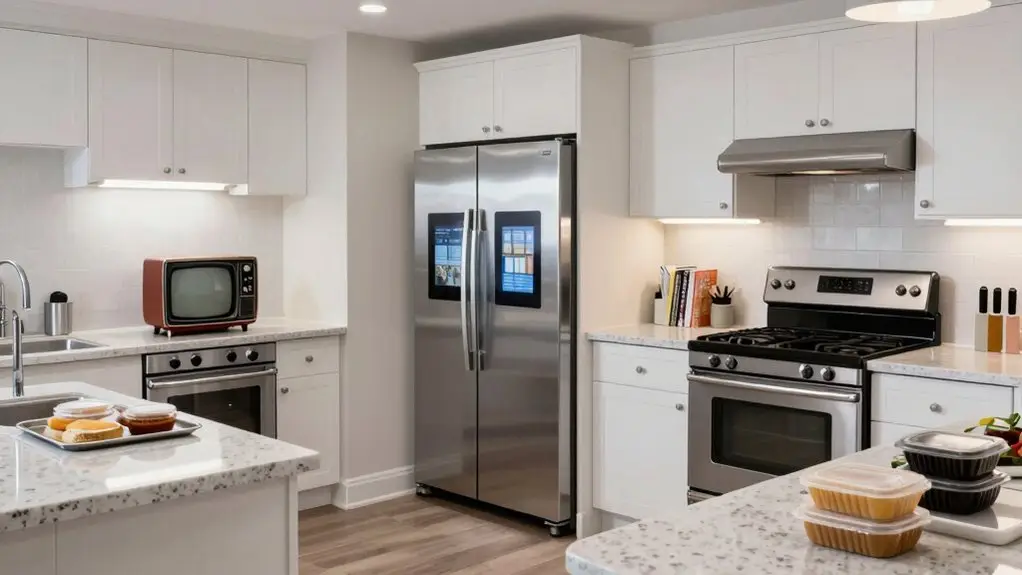
As more women headed to offices in the ’60s and ’70s, you started grabbing convenience wherever you could find it. Your freezer filled up fast with TV dinners, those compartmentalized trays promising hot meals without the hassle.
Then microwaves landed in your kitchen, and suddenly you’re zapping food in minutes—no pots, no pans, no problem.
Refrigerators kept evolving too, way past simple iceboxes. Now you’ve got smart fridges tracking expiration dates and letting you peek inside while you’re grocery shopping.
All this tech pushed you toward ready-to-heat everything.
You didn’t exactly stop cooking, but you definitely stopped cooking like they used to. Even outdoor cleanup got easier over the decades, with electric pressure washers making it simple to blast grease and grime off patios and grills without breaking a sweat.
The Open-Plan American Kitchen: Freedom and Frustration
You’ve probably walked into one of these spaces and felt that instant “wow” factor—sunlight streaming through, everyone hanging at the island, nobody crammed in a back-facing galley like your grandma’s house.
But here’s the thing: that wide-open flow, born from mid-century TV culture and suburban dreams of togetherness, comes with some real headaches when bacon grease meets your new couch.
Thankfully, you’re seeing clever fixes pop up everywhere, sliding glass panels and hidden vents, proving Americans aren’t ready to give up that social kitchen magic just yet. One increasingly popular upgrade is installing an LED track lighting system to give open kitchens flexible, zone-specific illumination without the commitment of recessed fixtures.
Open-Plan Origins
Although kitchens were once tucked away like secrets, the open-plan American kitchen burst onto the scene with a radical idea: cooking shouldn’t mean missing out on life happening just beyond the wall.
You can trace this shift through four key moments:
- The social fix – Early open layouts let women cook without disappearing from family life.
- Wright’s vision – Frank Lloyd Wright championed bringing labor out of isolation.
- The gathering era – By the 1990s, islands and sightlines turned cooking into group theater.
- The double edge – Freedom meant smells and sounds traveled too, sparking today’s sliding-door compromises.
The evolution of the American kitchen shows how kitchens have transformed from hidden workspaces to open, connected hubs. Today, homeowners updating these spaces often turn to affordable upgrades like a budget subway tile backsplash to preserve that open, polished aesthetic without overspending.
THE AMERICAN KITCHEN TRANSFORMED DOMESTIC LIFE WHEN THE KITCHEN BECAME THE HEART OF THE HOME—MESS, NOISE, AND ALL.
Spatial Flow Trade-offs
If you’re dreaming of knocking down walls to create that magazine-perfect open kitchen, you’re probably picturing sunlight streaming over your island while friends laugh at the breakfast bar.
Open-plan American kitchens promise exactly this—a seamless blend of cooking and living room energy, where you’re never cut off from the conversation.
Here’s the reality you’re signing up for.
That gorgeous open layout means cooking smells and heat don’t stay put; you’ll find yourself googling sliding glass doors to trap bacon grease before it reaches your sofa.
Your kitchen island becomes everything—prep station, dining spot, and storage hero—while counter space shrinks to precious real estate.
You’re constantly negotiating more openness versus enough room to actually chop vegetables without bumping elbows.
It’s freedom with a side of frustration.
One budget-friendly way to refresh your kitchen’s look without a full renovation is to install peel-and-stick tile backsplash along the wall behind your stove, adding personality without the mess of traditional tiling.
Modern Adaptation Pressures
Because you’re constantly multitasking in your kitchen, open-plan living still feels like the answer until it doesn’t.
The modern American kitchen promises connection, but you’re paying for it with noise, smells, and that island that somehow collects everyone’s junk.
- YOU’RE CHASING SOCIAL INTERACTION, NOT REALIZING THE COST UNTIL DINNER SMELLS INVADE YOUR LIVING ROOM.
- YOU’RE ADDING SLIDING GLASS DOORS TO RECLAIM CONTROL OVER COOKING CHAOS.
- YOU’RE DISCOVERING THAT ONE BIG ROOM DOESN’T MAKE THE KITCHEN EASIER—IT JUST EXPOSES THE MESS.
- YOU’RE FEELING THE COVID-ERA SHIFT PUSHING BACK, CRAVING QUIET CORNERS FOR CALLS AND HOMEWORK.
Across the United States, you’re rethinking whether freedom beats function.
Open-plan loyalty is cracking.
You’re adapting and reimagining flexible spaces that breathe without suffocating you.
When the clutter on that island finally breaks you, a premium garage organization system can pull the overflow out of your kitchen and restore some sanity to the space.
Marble Countertops and Massive Islands: When Kitchens Became Wealth
You’ve probably walked into a kitchen and immediately noticed that giant marble island, gleaming like a showroom centerpiece—it’s hard not to.
In post-war America, and especially during the 2000s McMansion boom, you started seeing kitchens designed less for cooking and more for showing off.
With sprawling open layouts and pricey finishes that screamed success, today, you might feel a little pressure to keep up.
Since social media and TV have made those oversized islands and luxe materials feel like the standard, not the exception.
The same obsession with premium surfaces has spilled onto outdoor living spaces, where homeowners are investing in professional deck staining equipment to maintain and elevate the look of their exterior wood features.
The Rise of Kitchen Status
Some kitchens whisper, but yours started shouting somewhere around the early 2000s. American kitchens transformed from work zones into billboards of success, and you felt the pressure to keep up.
Look at how status crept in:
- You traded practical Formica countertops for stone that costs more than your first car.
- Household appliances became steel behemoths you’d barely use.
- The McMansion kitchen made square footage the ultimate flex.
- Your modern kitchen became a status symbol before you even cooked a meal.
You’re measuring your space against photos you scroll at midnight, wondering why your 20-year-old renovation feels dated. The dream kitchen isn’t about cooking—it’s about proving you’ve arrived.
And honestly, you’re exhausted just staging it for guests who only see the waterfall edge. Even the overhead lighting matters now, with homeowners swapping outdated fixtures for sleek LED ceiling lights that signal a renovation is fresh, not forgotten.
Open-Concept Luxury Design
Although you mightn’t notice it at first, your kitchen has been performing for an audience since you moved in.
In the 2000s, open-concept luxury design took over American homes, turning cooking spaces into showpieces.
You’ve seen it: the white kitchen with marble countertops—Calacatta, Carrara, whatever screams “I made it.”
These kitchen designs blew out walls, merging with living areas so you’re never alone while sautéing.
Your island isn’t just for chopping; it’s a dining-table-sized stage with stools for spectators.
High-end finishes like Silestone or Dekton Aura15 make kitchens feel like prestige rooms, not utility closets.
Sliding glass doors manage smells without killing the vibe.
Technology as Wealth Signal
Often, you don’t realize your fridge is flexing on the neighbors until someone opens it and gasps. That’s when you see it—your American kitchen isn’t just for cooking, it’s a billboard for your success.
Cultural shifts turned these spaces into status symbols. You now chase marble countertops and massive appliances because magazines and New York design shows told you that’s what modern living looks like.
Your large island isn’t just prep space; it’s prime real estate that screams you’ve got room to spare.
Here’s how technology became your wealth signal:
- Side-by-side fridges with ice makers became must-haves.
- Gas ranges and double ovens showed serious culinary ambition.
- Smart appliances connected everything to your phone.
- Durable materials like Calacatta marble proved you’d arrived.
Your kitchen became a showroom, and you’re the star.
Universal Design: How Accessibility Laws Remade Kitchen Layouts
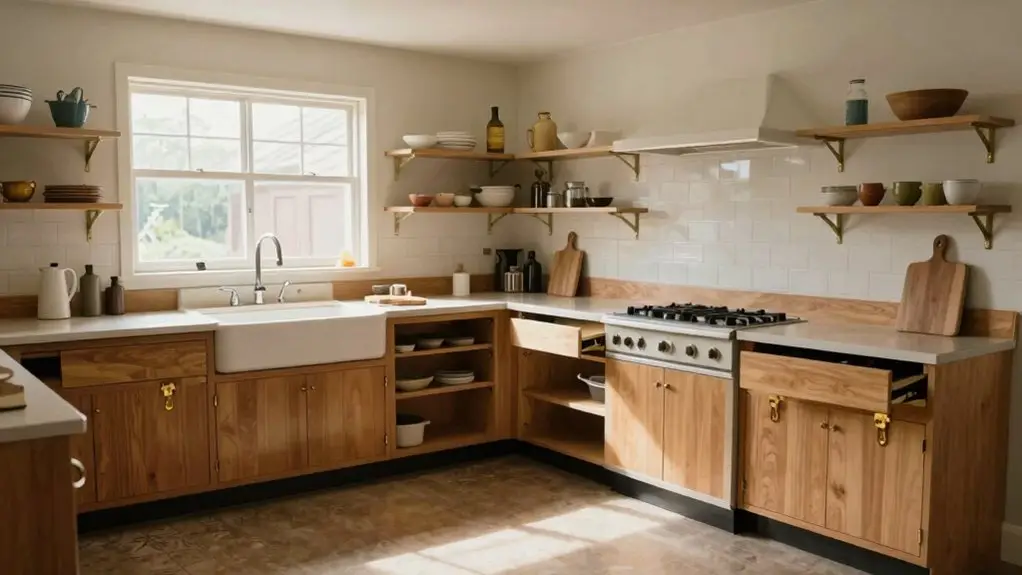
If you’ve ever pulled out a drawer that glides like butter or noticed how your countertops feel just the right height for chopping veggies, you’ve got the Americans with Disabilities Act to thank for that.
The 1990 ADA reshaped what you expect from a kitchen, pushing Universal design principles into everyday homes.
You’ll find accessible counter heights—typically 34 inches or lower—make cooking comfortable whether you’re tall, short, or using a wheelchair.
The ADA established reach ranges so you can grab what you need without straining.
Work areas now accommodate everyone.
That wheelchair-accessible sink you spotted features open space below so chairs roll right up.
Those frameless cabinets and soft-close drawers you love are accessibility innovations disguised as sleek upgrades.
Accessibility quietly revolutionized your kitchen.
Your Next Kitchen: Smaller, Smarter, and Possibly Walled Off
While open floor plans have dominated home design for decades, you’re noticing a quiet shift back toward kitchens that feel more intentional and enclosed. You’re embracing the small kitchen not as a compromise, but as a smarter choice that puts everything within reach.
The small kitchen isn’t a compromise—it’s a smarter choice that puts everything within reach.
Here’s what you’re prioritizing in modern kitchen design:
- U-shaped layouts that keep your food prep tight and efficient, no marathon walks required.
- Built-in storage reaching higher and deeper, reclaiming every inch.
- ADA considerations ensuring your space works for everyone who cooks.
- Walled-off zones controlling heat and noise, because nobody wants spaghetti sauce splatter on their Zoom call.
YOU’RE rediscovering what post-war builders knew: good design fits real life. Your elbows thank you for that 3-below-elbow countertop rule, too.
Final Thoughts
You’ve just toured a century of kitchen evolution, and maybe you’re wondering what’s next for your own space. Whether you’re dreaming of a massive island or secretly craving walls, the American kitchen keeps adapting to how you actually live.
It’s messy, hopeful, and always the heart of the home—flaws and all. So grab a seat at that oversized counter, accept the chaos, and make it yours. That’s the real American kitchen.